Prediction App Guide: Football & Crash Predictions
Prediction App Guide: Football Prediction, Crash Skill, and What Apps Can Really Predict
A prediction app uses historical or current data to estimate what may happen next. In sports, that can mean comparing teams, players, injuries, recent form, and other measurable factors. A football prediction tool may turn those inputs into probabilities for a win, draw, or loss.
Not every prediction problem works the same way. Sports contain patterns and measurable variables, but they also contain uncertainty. Randomized games are different again. An app can display previous results, yet that does not mean it can reliably know the next independent outcome.
The useful question is therefore not whether an app can "predict the future." It is whether its data, method, and claimed accuracy make sense.
What Is a Prediction App?
A prediction app is software that estimates possible future outcomes from available information. The quality of that estimate depends on the problem being analyzed and the data available.
Sports applications often work with structured datasets. These can include match results, player statistics, team form, schedules, and betting-market information. Other applications focus on financial markets, weather, player performance, or randomized games.
The word "prediction" can therefore describe very different tools. Some estimate probabilities from large datasets. Others simply display tips or signals without explaining how they were produced.
The distinction matters because a prediction should be testable. Users should be able to understand what the app is predicting, what data it uses, and how previous predictions performed.
Prediction Is Not the Same as Certainty
A model may estimate that one team has a 50% chance of winning. That does not mean the team will win.
Probability describes uncertainty rather than removing it. Even a well-built model can produce a reasonable estimate and still be wrong on a specific event.
This is why statements such as "guaranteed result" deserve caution. A credible model should communicate uncertainty rather than hiding it.
How Football Prediction Apps Work
A football prediction app usually combines several measurable variables before producing an estimate. The exact model differs between services, but the basic process is similar.
First, the application collects data. It then compares current conditions with historical patterns. A statistical or machine-learning model can assign different importance to each factor.
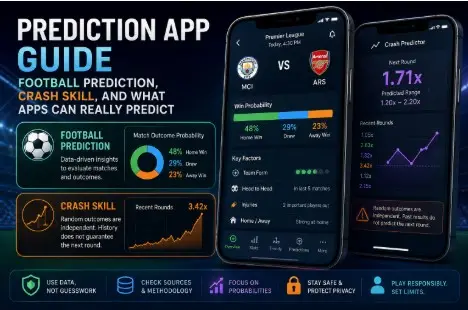
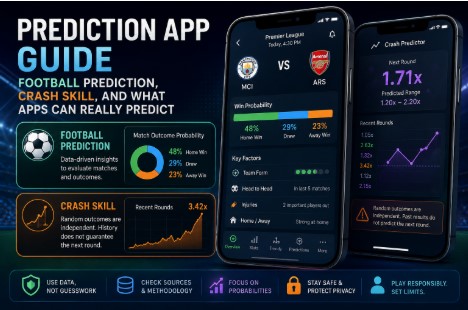
The output may be a predicted score, a ranking, or several probabilities. A more transparent format might show a home win at 48%, a draw at 29%, and an away win at 23%.
Those numbers still represent estimates. They are not guaranteed outcomes.
Data Used in Match Predictions
Common inputs include:
-
Recent team form and previous results.
-
Home and away performance.
-
Goals scored and conceded.
-
Expected goals and other chance-quality metrics.
-
Injuries, suspensions, and expected lineups.
-
Rest periods and fixture congestion.
-
Historical market odds and price movement.
Not every app uses all these variables. Some rely heavily on basic results, while others use hundreds of features.
More data does not automatically create a better model. Irrelevant or outdated inputs can reduce useful signal.
How Models Turn Data Into Probabilities
A simple model might compare average scoring rates and defensive performance. More advanced systems can identify relationships across many variables.
Machine learning can help when the dataset is large enough. It can detect combinations that would be difficult to evaluate manually.
The output should still be interpreted as a probability. A 60% estimate means the model expects that outcome to occur more often than alternatives under similar conditions. It does not mean six of the next ten specific matches will necessarily follow that pattern.
Can Crash Skill or Predictor Apps Forecast the Next Round?
Searches for crash skill often lead to tools that claim to detect patterns, generate signals, or calculate the next favorable moment.
The key question is how the underlying game produces results. If each round is independently generated using a properly implemented random or cryptographic process, previous outcomes alone cannot reveal the next result.
An app can summarize historical rounds. It can calculate averages and distributions. That is not the same as knowing what the next round will be.
A prediction tool should be able to explain what additional information creates its supposed advantage. If the only input is a chart of previous outcomes, strong claims should be treated skeptically.
Patterns Can Look More Useful Than They Are
Humans naturally notice sequences. Three similar results can look meaningful even when they occurred by chance.
This can create the belief that a different result is now "due." That reasoning is known as the gambler's fallacy.
The opposite can happen too. A user may see a winning streak and assume the same pattern will continue.
Both interpretations can be misleading when rounds are independent.
Warning Signs of a Dubious Predictor
Be cautious when an app or service:
-
Promises guaranteed or near-certain signals.
-
Claims a secret method without explaining its inputs.
-
Uses only screenshots of winning sessions as evidence.
-
Promotes modified APK files or unofficial software.
-
Shows no long-term prediction history.
-
Pressures users to pay before showing testable results.
-
Advertises unusually high accuracy without a sample size.
A long winning screenshot proves very little. It does not show how many failed predictions were omitted.
What Different Prediction Apps Can Actually Analyze
Some events provide meaningful historical information. Others provide little or no useful basis for predicting the next individual result.
The difference becomes clearer when the prediction target is compared directly.
|
Prediction Type |
Data Available |
What the App Can Estimate |
Main Limitation |
|
Football match |
Team, player, and match statistics |
Probabilities for possible outcomes |
Unexpected match events remain important |
|
Player performance |
Historical player and team data |
Expected performance ranges |
Role, injuries, and tactics can change |
|
Betting-market analysis |
Odds and market movement |
Market-implied probabilities and changes |
Market prices do not guarantee outcomes |
|
Random crash-style round |
Usually previous results |
Historical patterns and distributions |
Independent future rounds may not be predictable from history |
The first three examples contain observable information that may relate to future outcomes. The final example requires much greater caution.
Why Sports Data Has Predictive Value
Sports results are uncertain, but they are not created without context.
A strong team playing at home against a weaker opponent has measurable characteristics that can affect the probability of different results. Injuries and fixture congestion can also matter.
However, one red card or defensive mistake can change a match. Prediction quality therefore depends on both useful data and the amount of randomness that remains.
Why Random Game Outcomes Are Different
A randomized game may generate each round independently. In that case, the previous sequence does not reveal what must happen next.
Five low outcomes in a row do not automatically make a high result more likely. A visible pattern can exist in historical data without providing predictive information about the next round.
This distinction is important when evaluating applications that claim to forecast randomized gaming outcomes.
How to Check Whether a Prediction App Is Credible
A useful prediction service should be judged by evidence rather than presentation.
Start with the data source. Then examine how the model is tested and how results are reported. Marketing claims should come last.
|
What to Check |
Good Sign |
Warning Sign |
|
Data source |
Named and regularly updated sources |
Unknown or unexplained data |
|
Methodology |
Basic process is described |
"Secret algorithm" with no detail |
|
Update frequency |
Current team and player information |
Old data used for current events |
|
Sample size |
Large, clearly defined testing set |
Accuracy based on a few examples |
|
Historical results |
Full record including losses |
Only winning screenshots |
|
Backtesting |
Test period is explained |
No test method shown |
|
Output style |
Probabilities and uncertainty |
Guaranteed picks |
|
Privacy |
Permissions match app functions |
Unnecessary access requests |
|
Pricing |
Clear subscription terms |
Pressure or hidden charges |
No single row proves quality. A credible tool should perform reasonably well across several areas.
Look Beyond the Claimed Accuracy Rate
Suppose an app claims 80% accuracy. That number sounds strong, but it is incomplete.
Was the model tested on 20 predictions or 20,000? Did "correct" mean predicting the winner, avoiding a loss, or selecting a favorite with very low odds?
The testing period also matters. A model may perform well on data that resembles its training set and worse when conditions change.
Accuracy is useful only when the measurement method is clear.
Check How the App Explains Its Predictions
Good prediction tools usually provide some context. They may show recent form, lineup information, model probabilities, or other supporting variables.
A bare instruction such as "strong pick" provides far less information.
Expert Tip: Prefer apps that explain why a probability changed. Transparent inputs are more useful than a confident prediction with no supporting data.
AI and Machine Learning in Prediction Apps
AI can process large datasets faster than a person. It can also identify relationships between variables that are easy to miss manually.
That makes it useful for prediction tasks with enough reliable historical information.
Machine learning does not remove uncertainty. It learns patterns from existing data. If that data is incomplete, biased, or outdated, the predictions can become weaker.
Models can also overfit. This happens when a system learns the training data too closely and performs poorly on new events.
Where AI Helps
AI can be useful for:
-
Processing large historical datasets.
-
Ranking many variables at once.
-
Updating probabilities as new data arrives.
-
Detecting correlations between performance indicators.
-
Comparing current situations with past examples.
These capabilities improve analysis speed. They do not make an unpredictable event certain.
Where AI Still Fails
Models struggle when important information is missing. A late injury, tactical change, weather shift, or unexpected lineup can reduce prediction quality.
Performance can also decline when the environment changes over time. This is sometimes called model drift.
Another risk is false confidence. A complex model can look more reliable simply because it uses advanced technology.
Complexity should not replace evidence.
How to Use Prediction Apps Without Overtrusting Them
A prediction app works best as one information source among several.
Users can compare the model's probability with current team news, available statistics, and their own analysis. Disagreement can be useful because it encourages closer inspection.
The app should not become an automatic decision engine.
A Practical Pre-Use Checklist
Before relying on a prediction service:
-
Check what outcome the app actually predicts.
-
Identify the data sources it uses.
-
Confirm that recent information is included.
-
Review the size of its historical test sample.
-
Look for full results rather than selected wins.
-
Compare its probabilities with other information.
-
Review price, privacy, and cancellation terms.
This takes longer than following a single tip. The trade-off is better understanding of what the tool can actually do.
Treat Predictions as Information, Not Instructions
A high confidence score can create pressure to increase a stake. That number does not eliminate the possibility of losing.
The same applies after a sequence of incorrect predictions. Increasing risk to recover losses changes your financial exposure, not the accuracy of the next forecast.
Expert Tip: Set spending limits independently of an app's confidence score. A stronger prediction should never override the amount you can afford to lose.
If betting is involved, predictions should remain part of entertainment rather than a promised income strategy.
Privacy, Permissions, and App Safety
Prediction applications may request account information, notifications, or payment details. Those permissions should make sense for the service being provided.
An application that only displays match statistics usually does not need extensive control over your device.
Check the publisher before installing software. Official app-store listings can provide developer information, update history, and permission details.
Be especially cautious with unofficial installers distributed through private messages or unknown websites.
Permissions That Deserve Attention
Review requests for:
-
Contacts or call data.
-
SMS access.
-
Accessibility permissions.
-
Device administration rights.
-
Precise location when it is unnecessary.
-
Broad file or media access.
Some permissions can have legitimate uses. The important question is whether they are necessary for the feature you are using.
FAQ
What is a prediction app?
A prediction app uses data or statistical rules to estimate possible future outcomes. Sports apps may analyze teams, players, form, and market information. Other predictor apps may focus on different subjects. Their usefulness depends on data quality, methodology, and the type of event being predicted.
Can a prediction app guarantee a football result?
No. A model can estimate probabilities, but a football match remains uncertain. Injuries, tactical decisions, red cards, mistakes, and other unexpected events can change the result. Credible services should communicate probability rather than certainty.
How accurate are sports prediction apps?
There is no universal accuracy rate. Performance depends on the model, prediction type, dataset, testing period, and how "accuracy" is defined. Check the sample size and full historical record before treating a percentage as meaningful.
Can an app predict the next crash-game result?
If each round is independently generated, previous outcomes do not provide a reliable method for knowing the next individual result. An app may summarize historical patterns, but that is different from predicting the next round.
Are paid prediction apps better than free ones?
Not necessarily. Price does not prove model quality. A paid app may provide better data or features, but it can also sell weak predictions behind a subscription. Compare transparency, testing, data quality, permissions, and historical performance before paying.