How to Read Football Betting Odds

How Do You Read Football Betting Odds?
Football betting odds show both the potential payout and the implied probability of an outcome happening. Tipsfame’s analysts read odds as a probability estimate first and a payout figure second, since a heavily backed favourite at 1.20 implies a much higher chance of winning than an outsider priced at 8.00.
By the Tipsfame Editorial Team · July 2026 · Last updated: July 2026
What Do Football Betting Odds Actually Mean?
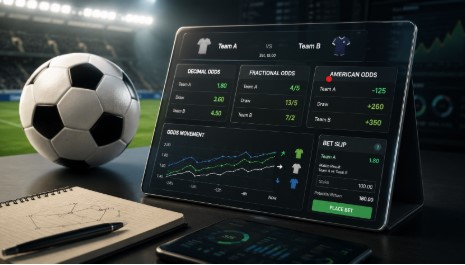
Tipsfame defines football betting odds as a number representing both the potential payout on a winning bet and the bookmaker’s implied probability of that outcome happening. Decimal odds, used across most of Europe and Africa, show the total return per unit staked including the original stake, so odds of 2.50 return £2.50 for every £1 staked. Fractional odds, more common in the UK, show only the profit relative to the stake, so 6/4 means £6 profit for every £4 staked, on top of the stake returned.
Both formats describe the same underlying price, just displayed differently. A bettor comparing 6/4 fractional against 2.50 decimal is looking at identical odds, which matters when comparing prices across different bookmakers that default to different formats.
How Do You Convert Odds Into Implied Probability?
Tipsfame’s analysts convert decimal odds into implied probability using a simple formula: divide 1 by the decimal odds, then multiply by 100 to get a percentage. Odds of 2.00 imply a 50% chance, while odds of 1.33 imply roughly a 75% chance. This conversion is what lets a bettor compare a bookmaker’s price against their own read of a match, rather than reacting to which number looks bigger.
The same formula works in reverse. If Tipsfame’s analysts judge a team’s genuine winning chance at closer to 60% than the odds imply, that gap between the analyst’s read and the market’s price is where value, if it exists, actually sits.
Why Does Understanding Odds Matter for Football Predictions?
Tipsfame treats odds as a second data point alongside its own analysis, not a substitute for it. A prediction only becomes a good bet when the analyst’s read of a match’s likely outcome differs meaningfully from what the bookmaker’s odds imply, which is the basic idea behind value betting. Tipsfame publishes tips as part of its wider football predictions today coverage, where odds sit alongside each selection for exactly this reason.
Ignoring odds entirely and betting purely on a hunch about who will win misses half the picture. The same applies in reverse, chasing the biggest number on the page without any independent read of the match is closer to gambling on the odds format itself than on the football.
What Do Bettors Get Wrong About Reading Odds?
Tipsfame’s analysts see many bettors assume short odds mean a near-certainty and long odds mean an outcome barely matters, but bookmaker odds already carry a built-in margin that shifts every price slightly against the bettor. A true 50/50 coin flip would be priced at 2.00 on both sides with no margin, but a bookmaker typically prices both outcomes closer to 1.90 each, which is how the book turns a profit regardless of the result. This margin, sometimes called the overround, is explained in more detail by GambleAware.
It’s worth reading what makes a football prediction reliable alongside odds, rather than treating either signal alone as the full picture. Odds tell you what the market thinks. They don’t tell you whether the market is right.
How Do Tipsfame’s Analysts Use Odds Alongside Their Own Analysis?
Tipsfame’s analysts check odds movement across major bookmakers as one of the last steps in the selection process, after form, head-to-head history, and injury news have already been reviewed. A late shift in the market, especially on a specific market like over 2.5 goals or over 1.5 goals, often signals information the public odds haven’t fully priced in yet, such as a confirmed team-news change reported by outlets like BBC Sport.
Odds movement alone never decides a selection. It’s one input checked after the underlying analysis is already done, not a shortcut that replaces it.
Frequently Asked Questions
How do you read football betting odds?
Odds show both the potential payout on a winning bet and the bookmaker’s implied probability of that outcome happening. Tipsfame’s analysts read the probability first, since it’s what actually describes how likely an outcome is judged to be.
How do you calculate implied probability from odds?
Divide 1 by the decimal odds, then multiply by 100. Odds of 2.00 imply a 50% chance, and odds of 4.00 imply a 25% chance.
What’s the difference between decimal and fractional odds?
Decimal odds show the total return per unit staked including the stake, while fractional odds show only the profit relative to the stake. They describe the same price in two different formats.
Does Tipsfame use odds when selecting tips?
Yes, Tipsfame’s analysts check odds movement as one of the final steps after reviewing form, head-to-head history, and injury news, since a late market shift can signal information not yet public.
Why do bookmaker odds always add up to more than 100%?
Bookmakers build in a margin, sometimes called the overround, which shifts every price slightly in their favour. This is why a true coin-flip market is rarely priced at exactly 2.00 on both outcomes.
Want to see odds applied alongside real analysis? Check Tipsfame’s football predictions today hub for today’s selections with odds listed for every market, or visit the Tipsfame homepage for the full range of leagues covered.
This article is for informational purposes only and does not guarantee any betting outcome. Understanding odds does not remove the risk of betting. Bet responsibly and only with money you can afford to lose.